Projekt tervezési terület (en)
NewPalace
.
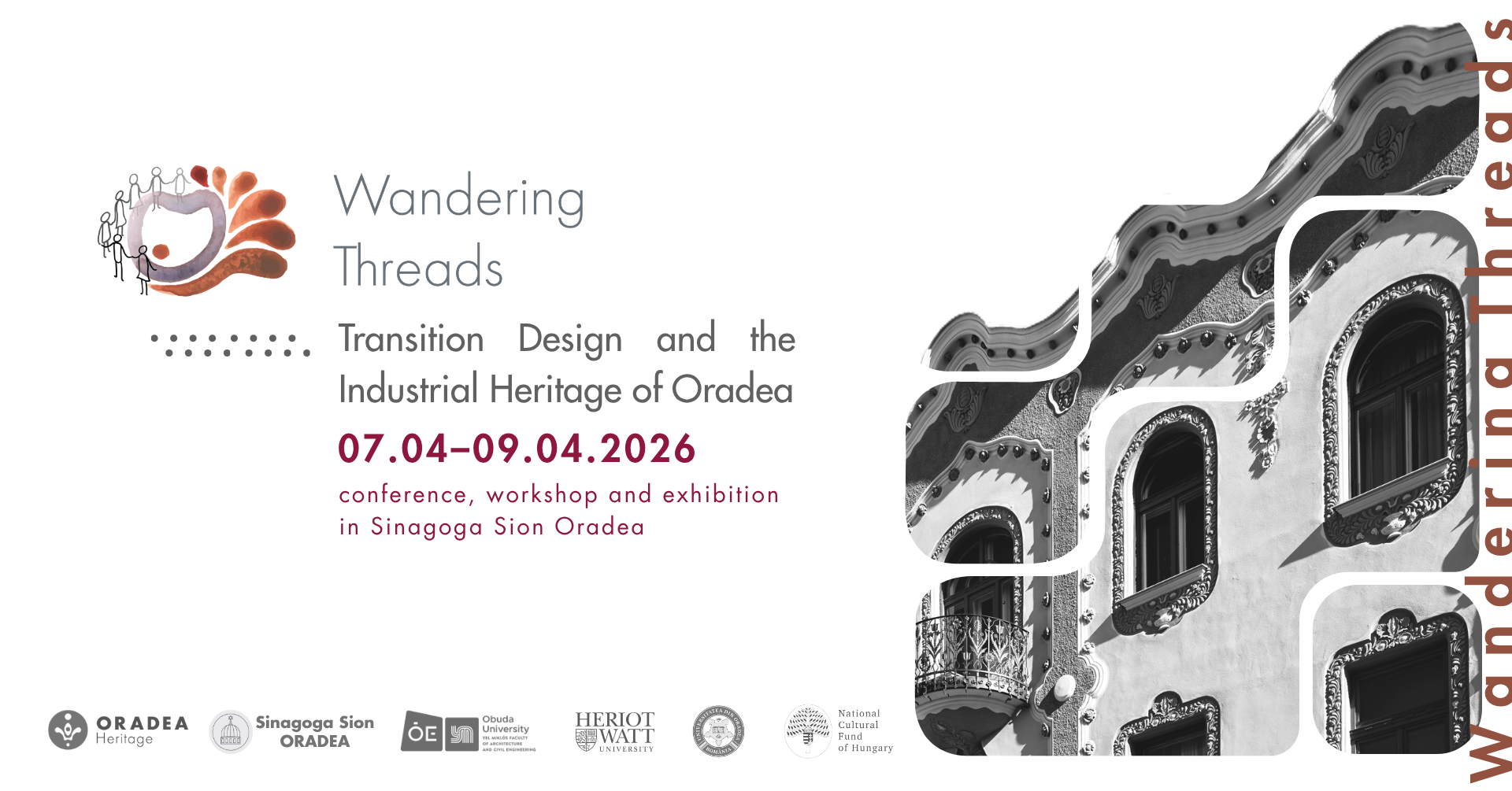
Wandering Threads - international program in Oradea
collaborationinternational program
In collaboration with three universities and as part of an international partnership, Ybl Faculty of Architecture and Civil Engineering organized a four-day interdisciplinary program in Oradea, Romania. The series of events, carried out in collaboration with Oradea Heritage (i.e., the Bihar County Monument Protection Foundation), covered a wide range of topics, from local values to global challenges, from light industry to the management of built heritage, and from theory to practice.
Among the partner universities were Edinburgh-based Heriot-Watt University—a leading technical and arts university in Scotland and the United Kingdom—and the Faculties of Arts and Architecture at the University of Oradea. The research areas of these diverse yet interconnected institutions spanned a wide range of current and forward-looking fields in the textile industry, visual arts, and architecture.
Oradea lies at the intersection of numerous, ever-changing commercial and cultural currents; the city has been shaped by the complex processes brought about by periods of dramatic social, political, and economic change. Both historical continuities and points of rupture are evident in the city’s physical and cultural heritage.
The program was housed in the Sion Neolog Synagogue, located in the heart of Oradea, whose industrial structures and fabric-like wall surfaces not only brought the theme into tangible proximity but appropriately framed the event. Its location, along with its proximity to the city’s business and former light industrial facilities and historic monuments, also made the building—which represents significant local cultural value—an excellent starting point.
The three-day event series took place from April 7 to 9, 2026, during which an exhibition gradually filled the synagogue’s space with various elements; in the mornings, workshops were held with the participation of local university students and master’s and doctoral students from the Ybl Faculty; while in the afternoons, English-language lectures, which were also open to the public, explored the physical and intellectual heritage of the light industry.
The fundamental premise of the program was to bring together design professionals, researchers, and representatives of the broader public—working across various media and scales—to collaborate within the framework of an experimental workshop. The past can provide inspiration for today’s urban planning, heritage management, and environmental sustainability. The exhibition also draws heavily on the concept of transition design and its three timeframes. Each transitional period evaluates and utilizes the conditions and achievements inherited from the past—though partly lost or hidden—in the context of present-day activities that contribute to shaping a different, yet hopefully more livable, future.
The workshop and exhibition provided a practical perspective, while the lectures offered a theoretical dimension and were enriched by presentations of useful and best practices by contemporary design and light industry professionals active in the region, alongside presentations of research by academic lecturers.